Discover the Enduring Impact of Don Quixote by Cervantes

Miguel de Cervantes’ Don Quixote, published in the early 17th century, is considered one of the most influential works of literature in the Western canon. This iconic novel has not only shaped the literary landscape but continues to captivate readers worldwide with its exploration of reality vs. illusion, chivalry, and social criticism.
As a literary masterpiece, it has inspired countless adaptations and interpretations, cementing its place in classic literature. The novel’s themes remain relevant today, making it a timeless classic that continues to resonate with audiences.
Key Takeaways
- Miguel de Cervantes’ novel has had a lasting impact on world literature.
- Don Quixote explores themes that remain relevant today.
- The novel is considered a literary masterpiece and a cornerstone of classic literature.
- Its influence can be seen in numerous adaptations and interpretations.
- The novel continues to captivate readers with its exploration of reality and illusion.
The Birth of a Masterpiece: Cervantes and His Time
In the 16th century, a period marked by significant cultural and literary shifts, Miguel de Cervantes emerged as a pivotal figure. This era, known as Spain’s Golden Age, was characterized by a flourishing of arts and literature, setting the stage for Cervantes’ contributions.
Miguel de Cervantes: The Man Behind the Legend
Miguel de Cervantes lived a life replete with adventure and hardship, experiences that profoundly influenced his writing. Born in 1547, Cervantes was a soldier, a tax collector, and a prisoner, among other roles, before becoming the renowned author of Don Quixote. His diverse life experiences not only shaped his perspective but also enriched his literary works.
Life Experiences That Shaped His Writing
Cervantes’ time as a soldier, particularly his involvement in the Battle of Lepanto, had a lasting impact on his life and writing. The injuries he sustained and the subsequent years as a captive in Algiers influenced his perspectives on honor, chivalry, and reality.
Literary Career Beyond Don Quixote
Beyond Don Quixote, Cervantes wrote several other notable works, including Novelas Ejemplares (Exemplary Novels) and Los Trabajos de Persiles y Sigismunda. These works showcased his versatility and depth as a writer, contributing significantly to Spanish literature.
Spain’s Golden Age: The Historical Context
Spain’s Golden Age was a period of cultural and literary renaissance. It was during this time that Cervantes, along with other luminaries such as Lope de Vega and Calderón de la Barca, made significant contributions to Spanish literature. The era was marked by a renewed interest in classical learning and the emergence of new literary forms.
| Author | Notable Work | Contribution |
|---|---|---|
| Miguel de Cervantes | Don Quixote | Considered the first modern novel, influencing literature worldwide. |
| Lope de Vega | Fuenteovejuna | Revolutionized Spanish theater with his prolific output and innovative storytelling. |
| Calderón de la Barca | La Vida es Sueño | Explored complex philosophical themes, enriching Spanish drama. |
Don Quixote by Cervantes: The Book That Changed the World
Cervantes’ Don Quixote is more than just a novel; it’s a cultural touchstone that has reshaped the literary landscape. Published in two parts, in 1605 and 1615, this influential work has had a lasting literary impact, making it a timeless classic.
Publication History and Initial Reception
Don Quixote was first published in 1605, and its initial reception was mixed. While some critics praised its innovative narrative, others saw it as a satire that mocked the chivalric romances of the time. Despite this, the book gained popularity, and its second part, published in 1615, further cemented its place in literary history.
Revolutionary Narrative Techniques
Cervantes employed several revolutionary narrative techniques that have influenced literature for centuries. Two of the most significant innovations were the use of an unreliable narrator and multiple perspectives.
The Unreliable Narrator
The narrator of Don Quixote is often considered unreliable, as he frequently interrupts the story, questions the authenticity of the events, and even presents alternative versions of the narrative. This technique adds complexity to the story, engaging readers and challenging their perceptions.
Multiple Perspectives and Layered Storytelling
Cervantes also used multiple perspectives and layered storytelling, techniques that were groundbreaking at the time. By presenting different viewpoints and embedding stories within the main narrative, he created a rich and layered tale that continues to captivate readers. Key aspects of this technique include:
- Presenting different narrative voices
- Embedding stories within the main narrative
- Creating a layered and complex story structure
These narrative innovations have had a lasting impact on literature, influencing generations of writers and cementing Don Quixote as a foundational work in the literary canon.
The Tale of the Ingenious Gentleman: Plot Overview
Don Quixote, the iconic character created by Cervantes, embarks on a journey that blurs the lines between reality and illusion. This seminal novel, Don Quixote, is divided into two parts, each detailing the adventures and misadventures of its protagonist.
The Knight’s First Adventures
In Part One, Don Quixote sets out on his first adventure, driven by his chivalric ideals and delusions of becoming a great knight-errant. He renames himself Don Quixote and begins to travel through the countryside of La Mancha, encountering various characters who are often perplexed by his actions. One of the pivotal characters he meets is Sancho Panza, his squire, who represents a pragmatic view of the world contrasting with Don Quixote’s idealism.
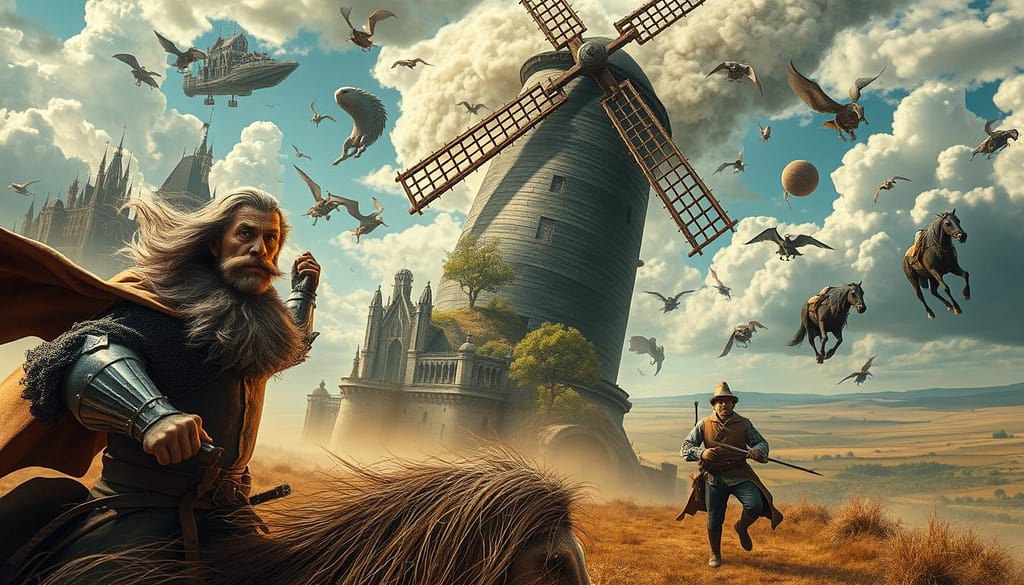
As Don Quixote travels, he mistakes windmills for giants and a group of traveling merchants for a band of robbers, leading to comedic misunderstandings. These episodes highlight the tension between Don Quixote’s perception of reality and the actual world around him.
Return of Don Quixote
In Part Two, Don Quixote continues his journey, but with a significant twist: he becomes aware that his adventures have been documented and published, making him a celebrity of sorts. This meta-fictional element adds a layer of complexity to the narrative.
The Meta-Fictional Twist
The meta-fictional twist in Part Two is a groundbreaking narrative technique where Don Quixote and Sancho Panza encounter characters who have read about their previous adventures in Part One. This self-aware storytelling challenges the boundaries between fiction and reality, making Don Quixote a precursor to modern literary innovations.
The Journey to Barcelona and Final Defeat
Don Quixote’s journey eventually leads him to Barcelona, where he faces defeat at the hands of the Knight of the White Moon. Forced to return home, Don Quixote renounces his chivalric ambitions and dies as Alonso Quixano, his real identity. This conclusion brings a poignant end to the story, highlighting the tragic elements of Don Quixote’s unwavering dedication to his ideals.

The plot of Don Quixote is a rich tapestry of adventure, satire, and philosophical introspection. Through its exploration of reality vs. illusion, Cervantes crafts a narrative that continues to captivate readers and inspire new adaptations and interpretations.
Unforgettable Characters of La Mancha
Don Quixote and his companions are more than just characters; they are archetypes that continue to captivate audiences worldwide. The richness of Cervantes’ characters lies in their complexity and the nuanced way they are woven into the narrative.
Don Quixote: The Idealistic Knight
Don Quixote, the eponymous hero, is an embodiment of idealism, driven by the chivalric romances he has read. His perception of reality is distorted, leading to a series of adventures that are both humorous and poignant. The character’s idealism is a commentary on the societal norms of Cervantes’ time, challenging the reader to reflect on the nature of reality and illusion.
Sancho Panza: The Pragmatic Squire
Sancho Panza, Don Quixote’s squire, represents pragmatism and practicality. He is grounded in reality, often serving as a foil to Don Quixote’s idealistic endeavors. Their relationship is central to the narrative, highlighting the contrast between the ideal and the real, and the ways in which these two perspectives interact.
Supporting Characters and Their Significance
The narrative is also populated by a range of supporting characters, each contributing to the richness of the story. These characters, from the goatherd to the priest, play crucial roles in shaping the themes and the plot. Key themes such as reality vs. illusion, chivalry, and social criticism are explored through these characters’ interactions. Some of the notable supporting characters include:
- The goatherd, who represents a simpler, more rustic way of life.
- The priest and the barber, who embody the societal norms and critique Don Quixote’s actions.
- Dulcinea del Toboso, the object of Don Quixote’s chivalric endeavors, symbolizing the ideal of courtly love.
Together, these characters create a vibrant tapestry that has made Don Quixote a timeless classic of Spanish literature.
Exploring the Novel’s Profound Themes
At its core, Don Quixote is a novel that delves into the intricacies of human perception, challenging the boundaries between reality and illusion. This theme is central to understanding the novel’s impact on literature and its continued relevance today.
Reality vs. Illusion: The Central Conflict
The novel’s protagonist, Don Quixote, embodies the conflict between reality and illusion. His perception of reality is distorted by the chivalric romances he has read, leading him to embark on a series of adventures that blur the lines between reality and fantasy.
This theme is not only reflected in Don Quixote’s actions but also in the reactions of those around him, including his squire Sancho Panza, who often finds himself caught between his loyalty to his master and the harsh realities of their situation.
Chivalry, Honor, and Social Criticism
Cervantes uses Don Quixote’s adventures to critique the romantic chivalric novels of his time, exploring themes of honor and social criticism. Through Don Quixote’s misadventures, Cervantes satirizes the ideals of chivalry, revealing the disconnect between the romanticized notion of knighthood and the reality of life in 17th-century Spain.
| Theme | Description | Example from the Novel |
|---|---|---|
| Reality vs. Illusion | The conflict between Don Quixote’s perception of reality and the actual reality | Don Quixote’s mistaking windmills for giants |
| Chivalry and Honor | Critique of the romanticized ideals of knighthood | Don Quixote’s tilting at windmills |
| Social Criticism | Satire of the social norms and classes of 17th-century Spain | The treatment of Sancho Panza by the nobility |
Identity and Self-Transformation
Throughout the novel, Don Quixote undergoes a transformation, not just in his perception of reality but also in his understanding of himself. This transformation is mirrored in Sancho Panza, who evolves from a simple squire to a more complex character with his own insights and motivations.
The exploration of identity and self-transformation in Don Quixote adds depth to the novel, inviting readers to reflect on their own understanding of themselves and their place in the world.
Literary Innovations That Redefined Fiction
Cervantes’ masterpiece, Don Quixote, introduced groundbreaking literary innovations that redefined fiction. As a pioneering work, it not only reflected the societal norms of its time but also paved the way for future literary endeavors.
Birth of the Modern Novel
The impact of Don Quixote on literature was profound, marking a significant departure from traditional storytelling methods. Cervantes achieved this through several key techniques.
Breaking from Medieval Storytelling Traditions
Cervantes broke away from medieval narrative structures by introducing a more realistic and nuanced approach to storytelling. This shift was revolutionary, as it moved away from the idealized portrayals common in chivalric romances.
Character Development and Psychological Depth
One of the most significant innovations was the development of complex characters with psychological depth. Don Quixote and Sancho Panza are exemplary in this regard, offering readers a nuanced exploration of their thoughts and motivations.
Metafiction and Self-Awareness in Storytelling
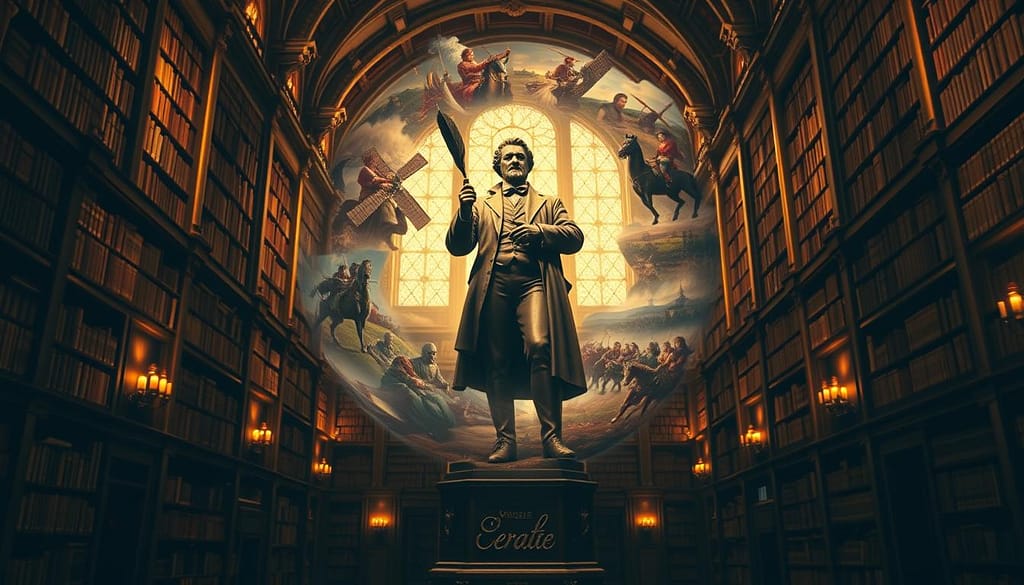
Don Quixote also explored metafiction, where the narrative self-consciously addresses the reader or comments on its own status as a fictional work. This technique added layers of complexity to the story, engaging readers on multiple levels.
By pushing the boundaries of narrative, Cervantes created a work that continues to influence literature today. The influential novel remains a cornerstone of literary studies, offering insights into the power of storytelling and character development.
As we reflect on the literary impact of Don Quixote, it’s clear that Cervantes’ book was more than just a tale of adventure; it was a catalyst for change in the literary world.
Global Reach and Translations
Translating Don Quixote, a masterpiece deeply rooted in Spanish culture, has been a daunting task, yet it’s through these translations that the novel has achieved its global reach. The process of translating this iconic work has not only introduced Cervantes’ genius to new audiences but has also presented translators with the challenge of conveying the nuances of the original text.
Translating a Cultural Icon
The challenge of translating Don Quixote lies in its rich cultural context, complex characters, and the play on words that Cervantes masterfully wove into the narrative. Translators must navigate the fine line between remaining faithful to the original text and making it accessible to readers in other languages. As Edith Grossman, a renowned translator of Spanish literature, notes, “Translation is not a matter of words only: it is a matter of making intelligible a whole culture.”
This task requires not just linguistic expertise but also a deep understanding of the historical and cultural references embedded in the novel. The translation of Don Quixote is further complicated by its metafictional elements and the interplay between reality and illusion, themes that are central to the narrative.
Cultural Adaptations Across Languages
Don Quixote has been adapted and translated in numerous ways across different cultures, reflecting the diverse perspectives and creative liberties taken by translators and adapters. These adaptations range from literal translations that stick closely to the original text to more interpretive versions that reinterpret the narrative for new audiences.
Notable English Translations Through History
English translations of Don Quixote have a long history, with the first translation appearing in the early 17th century. Notable translators include Thomas Shelton, whose 1612 translation is considered one of the best of its time, and Edith Grossman, whose 2003 translation is praised for its fidelity to the original while being accessible to modern readers.
How Translation Choices Affect Interpretation
The choices made by translators can significantly affect how Don Quixote is interpreted by readers. For instance, the translation of certain phrases or the interpretation of cultural references can alter the perceived character of Don Quixote and Sancho Panza. As
“Translation is not just about replacing words; it’s about conveying the spirit of the work.”
This highlights the importance of translation in shaping our understanding of literary classics.
Don Quixote’s Influence on World Literature and Arts
The influence of Don Quixote extends far beyond its original publication, shaping literature and artistic expression for centuries. As a foundational work of literature, it has inspired countless authors, artists, and creators across various mediums.
Literary Descendants: From Dickens to Dostoyevsky
Don Quixote’s impact on literature is evident in the works of many renowned authors. Writers such as Charles Dickens and Fyodor Dostoyevsky have drawn inspiration from Cervantes’ masterpiece. For instance, Dickens’ The Pickwick Papers reflects the picaresque nature of Don Quixote, while Dostoyevsky’s The Idiot explores similar themes of reality vs. illusion.
Beyond Books: Film, Music, and Visual Arts
Don Quixote’s influence extends into various art forms, including film, music, and visual arts. Its themes and characters have been reinterpreted in numerous adaptations and works inspired by Cervantes’ novel.
Iconic Visual Interpretations by Doré and Picasso
Artists like Gustave Doré and Pablo Picasso have created iconic works inspired by Don Quixote. Doré’s illustrations brought the characters to life, while Picasso’s interpretations captured the novel’s essence in his unique style.
Modern Adaptations in Cinema and Theater
Modern adaptations of Don Quixote continue to thrive in cinema and theater. Films and stage productions have reimagined the story in contemporary settings, demonstrating the novel’s enduring appeal. These adaptations highlight the versatility and timeless relevance of Cervantes’ work.
Conclusion: The Eternal Knight of La Mancha
The literary masterpiece, don quixote by cervantes, continues to captivate readers worldwide with its timeless themes and memorable characters. As a pioneering work of fiction, cervantes novel has left an indelible mark on the literary landscape.
Don Quixote’s influence extends far beyond the realm of literature, inspiring countless adaptations in film, music, and visual arts. The iconic knight’s idealism and chivalry remain a powerful symbol, resonating with audiences across cultures and generations.
As we reflect on the significance of this literary masterpiece, it becomes clear that its impact will continue to be felt for generations to come. The eternal knight of La Mancha remains an enduring figure, inspiring new generations of readers and writers alike.
FAQ
What is the significance of Don Quixote in literature?
Don Quixote, written by Miguel de Cervantes, is considered a foundational work of modern literature, influencing countless authors and literary movements. Its exploration of reality vs. illusion, chivalry, and social criticism continues to captivate readers worldwide.
Who is Don Quixote and what is his story?
Don Quixote is the protagonist of Cervantes’ novel, an idealistic nobleman who becomes obsessed with chivalric romances and embarks on a series of adventures with his squire, Sancho Panza. The novel follows their journey as they navigate a complex web of reality and illusion.
What is the historical context of Don Quixote?
Don Quixote was written during Spain’s Golden Age, a period of cultural and literary flourishing. Cervantes’ work reflects the societal and cultural changes occurring during this time, including the decline of chivalry and the rise of modernity.
How did Don Quixote influence the development of the novel?
Don Quixote’s innovative narrative techniques, including the use of an unreliable narrator and multiple perspectives, marked a significant departure from traditional storytelling methods. This influenced the development of the modern novel, shaping the work of generations of writers.
What are the major themes explored in Don Quixote?
The novel explores a range of themes, including reality vs. illusion, chivalry, honor, social criticism, identity, and self-transformation. These themes continue to resonate with readers today, making Don Quixote a timeless classic.
How has Don Quixote been translated and adapted across cultures?
Don Quixote has been translated into many languages, with various cultural adaptations occurring across different cultures. The novel’s translation has played a crucial role in its global reach, allowing readers worldwide to engage with this literary masterpiece.
What is the significance of Don Quixote’s characters?
The characters in Don Quixote, including Don Quixote and Sancho Panza, are multidimensional and richly drawn, making them relatable and human. Through their interactions and experiences, Cervantes masterfully explores the human condition.
How has Don Quixote influenced art and culture beyond literature?
Don Quixote has inspired works beyond literature, including film, music, and visual arts. The novel’s influence can be seen in many areas of art and culture, a testament to its enduring impact.
What is the legacy of Don Quixote in modern times?
Don Quixote remains a powerful symbol in literature, inspiring new generations of readers and writers alike. Its continued relevance in modern times is a testament to the timeless appeal of this iconic novel.