“The Pilgrim’s Progress” by John Bunyan (1678)

For over three centuries, a timeless classic has captivated readers worldwide. First published in 1678, this allegorical masterpiece has stood the test of time, continuing to inspire and influence literature to this day.
Written by John Bunyan, this enduring narrative follows the journey of a pilgrim as he navigates the challenges of the Christian life. Its themes of perseverance, faith, and redemption remain universally relevant.
Key Takeaways
- A classic tale that has been a cornerstone of literature for centuries.
- Explores universal themes that remain relevant today.
- An allegory that has inspired countless adaptations and interpretations.
- Continues to be a significant influence on literary works.
- A testament to the power of storytelling and its ability to transcend time.
Historical Context and John Bunyan’s Life
The historical context and John Bunyan’s personal experiences played a pivotal role in shaping the narrative of ‘The Pilgrim’s Progress.’ To understand the depth of this allegory, it’s crucial to explore Bunyan’s life and the religious climate of 17th-century England.
Bunyan’s Personal Journey and Imprisonment
John Bunyan was born in 1628 in Harrowden, England. His early life was marked by a tumultuous spiritual journey, which eventually led him to become a Baptist minister. Bunyan’s strong convictions often put him at odds with the religious authorities of the time, leading to his imprisonment in 1660 for unlicensed preaching. During his imprisonment, Bunyan began to write, and it was here that the seeds of ‘The Pilgrim’s Progress’ were sown. His personal journey, including his struggles and spiritual insights gained during imprisonment, significantly influenced the narrative and themes of his masterpiece.
17th Century Religious Climate in England
The 17th century was a period of significant religious upheaval in England. The English Reformation had created a complex religious landscape, with tensions between the Church of England and various Nonconformist groups. Bunyan, as a Nonconformist Baptist, was part of a movement that sought greater religious freedom and purity. The religious climate of the time, characterized by persecution and debate, is reflected in ‘The Pilgrim’s Progress.’ Bunyan’s allegory resonated with many who were experiencing similar struggles, making it a powerful and enduring work.
The intersection of Bunyan’s personal experiences and the broader religious context of his time gave ‘The Pilgrim’s Progress’ its unique character and contributed to its widespread influence.
Overview of “The Pilgrim’s Progress” by John Bunyan (1678)
The Pilgrim’s Progress, written by John Bunyan in 1678, is a seminal work in Christian allegory that has left an indelible mark on English literature.
This book has been a cornerstone of Christian literature since its publication, with its narrative deeply rooted in the religious and social context of 17th-century England. The work is an allegory that follows the journey of Christian, a pilgrim who embarks on a perilous path to the Celestial City.
Publication History and Editions
The first edition of The Pilgrim’s Progress was published in 1678, and it was followed by a second part in 1684. The book gained immediate popularity, with multiple editions being published in the years following its initial release. The various editions and translations of the book underscore its widespread influence and enduring appeal.
Over the centuries, The Pilgrim’s Progress has been illustrated, abridged, and adapted, demonstrating its versatility and the timeless nature of its themes.
Structure and Literary Form
The Pilgrim’s Progress is structured as an allegory, with characters and events symbolizing the Christian faith journey. The narrative is divided into two parts: the first follows Christian’s journey, while the second part recounts the journey of Christiana, his wife, and their children.
The book’s allegorical form allows Bunyan to explore complex theological themes and moral lessons, making it a rich and layered work that has captivated readers for centuries.

Plot Summary: Christian’s Journey to the Celestial City
In ‘The Pilgrim’s Progress,’ Christian embarks on a transformative journey, symbolizing the spiritual struggles and triumphs of the Christian life. This narrative is a compelling representation of the moral lessons and spiritual growth inherent in the Christian faith.
The Burden and Departure from the City of Destruction
Christian’s journey begins in the City of Destruction, where he is burdened by the weight of his sins. As he sets out towards the Celestial City, he leaves behind the familiar, facing uncertainty and danger. This departure signifies the initial step in a Christian’s spiritual journey, marked by a recognition of one’s sins and a desire for redemption.
The burden on Christian’s back is a powerful symbol of the weight of sin that individuals carry until they find salvation. As noted by Bunyan, “the burden was not lightened” until Christian reached the cross, highlighting the significance of faith in Christ for the forgiveness of sins.
Key Locations and Challenges
Along his journey, Christian encounters various locations and challenges that test his resolve and faith. These include:
- The Slough of Despond, representing despair and the struggle with doubt.
- The Hill of Difficulty, symbolizing the challenges faced in maintaining one’s faith.
- The Valley of the Shadow of Death, embodying the fear of death and the unknown.
Each of these challenges serves as a moral lesson, teaching Christian (and the reader) about perseverance, trust in God, and the importance of community and guidance on the spiritual journey.
Arrival at the Celestial City
Upon finally arriving at the Celestial City, Christian is welcomed into the presence of God, having shed his burden and been transformed by his experiences. This arrival symbolizes the ultimate goal of the Christian faith: to achieve salvation and eternal life with God.
“And with that Christian and Hopeful went out of the river. Now, as soon as they got out, they knew not what to do; for they were so dazzled with the light and glory of that place that their sight was lost.”
This moment underscores the joy and glory of the spiritual journey’s end, where the faithful are rewarded with eternal peace and communion with God.
| Location | Symbolism |
|---|---|
| The Slough of Despond | Despair and doubt |
| The Hill of Difficulty | Challenges in maintaining faith |
| The Valley of the Shadow of Death | Fear of death and the unknown |
Part Two: Christiana’s Pilgrimage
In the second part of ‘The Pilgrim’s Progress,’ Christiana embarks on a journey that parallels Christian’s, yet distinctively her own. This narrative continuation explores the trials and tribulations faced by Christiana and her companions as they follow the path to the Celestial City.
Following in Christian’s Footsteps
Christiana’s journey is characterized by her determination to follow in Christian’s footsteps, retracing the path he took to the Celestial City. She is accompanied by a group that includes her children and other significant characters, each contributing to the narrative’s depth. The challenges they face are reminiscent of those encountered by Christian, serving as a testament to the enduring nature of the pilgrimage.

Differences from Christian’s Journey
While Christiana’s pilgrimage mirrors Christian’s in many respects, there are notable differences. Christiana’s journey is more socially oriented, involving interactions with a wider range of characters, including women, which adds a new dimension to the narrative. The experiences and challenges faced by Christiana and her companions also highlight the personal and relational aspects of the pilgrimage, distinguishing it from Christian’s more solitary journey.
| Aspect | Christian’s Journey | Christiana’s Journey |
|---|---|---|
| Companions | Largely solitary | Accompanied by family and others |
| Challenges | Focused on personal spiritual struggles | Includes social and relational challenges |
| Narrative Focus | Individual perseverance | Community and support |
This comparison underscores the richness of Bunyan’s narrative, offering insights into the classic novel’s exploration of spiritual journeys in a 17th-century context. Christiana’s pilgrimage enriches the reader’s understanding of the themes and challenges presented in “The Pilgrim’s Progress,” a seminal work of christian literature.
Key Characters and Their Symbolic Meanings
In ‘The Pilgrim’s Progress,’ John Bunyan masterfully crafts characters that embody various virtues and vices, guiding Christian on his spiritual journey. These characters are not merely figures in a narrative; they are symbolic representations that convey deeper spiritual truths, making the allegory rich and layered.

Christian and His Development
Christian, the protagonist, represents the everyman on a spiritual journey. His development throughout the narrative symbolizes the growth and challenges faced by individuals seeking spiritual enlightenment. Initially burdened by the weight of his sins, Christian’s journey is marked by trials that test his faith and resolve. As he progresses, he becomes more resolute, illustrating the transformative power of perseverance and faith.
Guides and Helpers
Characters like Evangelist and Interpreter serve as guides and helpers, providing crucial assistance and guidance to Christian. Evangelist directs Christian towards the path of righteousness, while Interpreter offers explanations that deepen Christian’s understanding of his journey. These characters symbolize the importance of spiritual guidance and mentorship in one’s faith journey.
Antagonists and Tempters
Conversely, characters such as Apollyon and Demas act as antagonists and tempters, embodying the challenges and temptations that believers face. Apollyon’s fierce battle with Christian represents the struggle against sin and adversity, while Demas’s temptation to abandon the pilgrimage for worldly gain symbolizes the lure of materialism and the ease with which one can be swayed from their spiritual path.
Secondary Characters and Their Significance
Secondary characters like Faithful and Hopeful also play significant roles. Faithful’s steadfastness until death underscores the theme of martyrdom and the cost of discipleship, while Hopeful’s optimism highlights the importance of maintaining hope in the face of adversity. Together, these characters enrich the narrative, illustrating various aspects of the Christian faith and the virtues required to reach the Celestial City.
In conclusion, the characters in ‘The Pilgrim’s Progress’ are intricately woven into the fabric of Bunyan’s allegory, each contributing to the rich tapestry of themes and moral lessons. As a literary classic and a cornerstone of religious fiction, ‘The Pilgrim’s Progress’ continues to captivate readers with its timeless exploration of the human spirit, firmly establishing its place in the canon of english literature classic.
Religious Themes and Spiritual Symbolism
As a seminal work of 17th-century literature, “The Pilgrim’s Progress” explores complex spiritual themes through its narrative. This iconic book has been a cornerstone of religious literature since its publication, offering readers a rich tapestry of allegory and symbolism.
The Christian Faith Journey
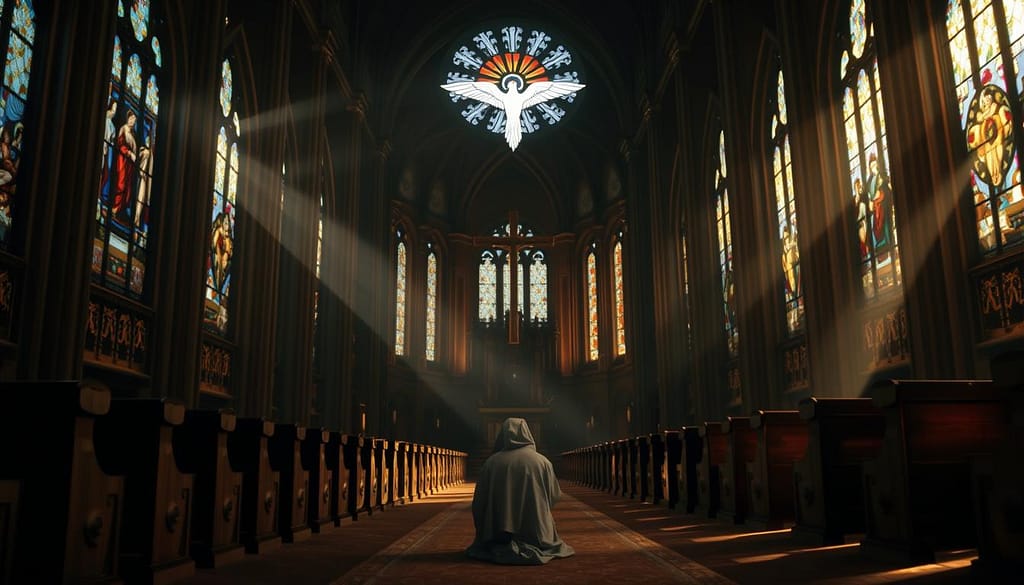
The narrative follows Christian’s journey, symbolizing the struggles and triumphs of the Christian faith journey. This pilgrimage is fraught with challenges, representing the moral and spiritual tests faced by believers. Through Christian’s experiences, Bunyan illustrates the path to spiritual enlightenment and salvation.
Biblical Parallels and References
“The Pilgrim’s Progress” is replete with biblical parallels and references, underscoring its roots in Christian scripture. Bunyan draws heavily from the Bible, incorporating elements that reflect its teachings and themes. This use of biblical allegory adds depth and meaning to the narrative, making it a powerful tool for religious education.
Moral Lessons and Teachings
The story is designed to impart moral lessons and teachings, guiding readers on their own spiritual journeys. Through the characters and events, Bunyan conveys important messages about faith, perseverance, and the nature of good and evil. The moral framework provided by the narrative has made it an enduring and influential work of religious literature.
| Theme | Symbolism | Moral Lesson |
|---|---|---|
| The Journey | Path to Salvation | Perseverance is key |
| Characters | Representations of Virtues and Vices | The struggle between good and evil |
| Challenges | Trials and Tribulations | Faith and resilience are crucial |
In conclusion, “The Pilgrim’s Progress” is a masterpiece of religious literature that continues to inspire and educate readers. Its exploration of religious themes and spiritual symbolism provides a profound understanding of the Christian faith journey.
Literary Significance and Critical Reception
John Bunyan’s “The Pilgrim’s Progress” is a literary masterpiece that has stood the test of time. Since its publication in 1678, it has been a cornerstone of classic English literature, influencing numerous authors and literary works.
Its impact on English literature is multifaceted. “The Pilgrim’s Progress” has been a source of inspiration for many writers, including notable figures like Jonathan Swift and Jane Austen. The book’s allegorical style and themes have become a benchmark for Christian allegories in literature.
Impact on English Literature
The book’s influence can be seen in various literary genres, from novels to poetry. Its themes of perseverance and faith have resonated with authors across centuries. For instance, the character of Christian has become an archetype in literature, symbolizing the struggles and triumphs of the human spirit.
| Author | Work | Influence |
|---|---|---|
| Jonathan Swift | Gulliver’s Travels | Allegorical style |
| Jane Austen | Pride and Prejudice | Themes of moral journey |
Critical Analysis Through the Centuries
“The Pilgrim’s Progress” has undergone extensive critical analysis since its publication. Critics have praised its rich symbolism, complex characters, and the depth of its themes. The book has been analyzed from various perspectives, including theological, historical, and literary.

The critical reception has evolved over time, with early critics focusing on its theological significance and later critics examining its literary merit. Today, “The Pilgrim’s Progress” is recognized as a seminal work in the English literary canon, celebrated for its enduring themes and universal appeal.
Modern Relevance and Contemporary Interpretations
Despite being written centuries ago, ‘The Pilgrim’s Progress’ continues to resonate with contemporary audiences. Its themes and allegories remain pertinent, offering insights into the human condition that are still relevant today.
Relevance to Today’s Readers
The spiritual journey undertaken by Christian in the allegory continues to inspire readers. The challenges and temptations faced by Christian are universal, making the narrative relatable to modern readers navigating their own life challenges.
Use in Religious Education and Study
‘The Pilgrim’s Progress’ is widely used in religious education to illustrate key religious themes and moral lessons. Its use in study groups and classrooms helps to deepen understanding of Christian faith and practices.
Secular Appreciation and Universal Themes
Beyond its religious significance, ‘The Pilgrim’s Progress’ is appreciated for its universal themes of perseverance, redemption, and personal growth. These themes are explored in various adaptations and interpretations across different media.

| Aspect | Relevance | Interpretation |
|---|---|---|
| Spiritual Journey | Personal growth and challenges | Relatable to modern life’s struggles |
| Religious Themes | Illustrates Christian faith | Used in religious education |
| Universal Themes | Perseverance and redemption | Appreciated across different cultures |
Conclusion: The Enduring Legacy of “The Pilgrim’s Progress”
“The Pilgrim’s Progress” by John Bunyan remains a timeless classic, continuing to captivate readers with its powerful themes and symbolism. This 17th-century allegory has traversed centuries, maintaining its relevance in contemporary times.
The journey of Christian, as depicted by Bunyan, is a testament to the human spirit’s quest for spiritual enlightenment. The book’s exploration of faith, perseverance, and redemption continues to inspire readers worldwide.
As a classic book, “The Pilgrim’s Progress” has left an indelible mark on literature and continues to be studied in religious and academic contexts. John Bunyan’s masterpiece is a rich tapestry of biblical parallels and moral lessons, offering insights into the human condition.
The enduring legacy of “The Pilgrim’s Progress” is a reflection of its universal themes and the profound impact it has had on readers throughout history. As we continue to navigate the complexities of modern life, Bunyan’s work remains a beacon of hope and guidance.
FAQ
What is “The Pilgrim’s Progress” about?
“The Pilgrim’s Progress” is a Christian allegory written by John Bunyan, published in 1678. It follows the journey of Christian, a pilgrim, as he travels from the City of Destruction to the Celestial City, facing various challenges and moral lessons along the way.
Who was John Bunyan, and why did he write “The Pilgrim’s Progress”?
John Bunyan was a 17th-century English writer and preacher who wrote “The Pilgrim’s Progress” during his imprisonment for his nonconformist views. The book reflects his personal journey and spiritual experiences, as well as the religious climate of the time.
What is the significance of “The Pilgrim’s Progress” in English literature?
“The Pilgrim’s Progress” is considered a classic of English literature, influencing many writers and literary works. Its significance lies in its exploration of Christian themes, moral lessons, and spiritual symbolism, making it a timeless and universal work.
What are the key themes in “The Pilgrim’s Progress”?
The key themes in “The Pilgrim’s Progress” include the Christian faith journey, biblical parallels and references, and moral lessons and teachings. The book explores the spiritual growth and development of the protagonist, Christian, as he navigates various challenges and trials.
Is “The Pilgrim’s Progress” still relevant today?
Yes, “The Pilgrim’s Progress” remains relevant today, offering insights into the Christian faith and spiritual journey. Its themes and symbolism continue to resonate with readers, making it a valuable resource for religious education and personal reflection.
What is the difference between Christian’s and Christiana’s journeys in “The Pilgrim’s Progress”?
Christiana’s journey, depicted in the second part of “The Pilgrim’s Progress,” follows a similar path to Christian’s, but with distinct differences. Christiana’s journey is often seen as more nuanced and complex, exploring themes of community, family, and social responsibility.
How has “The Pilgrim’s Progress” been received by critics and scholars over the centuries?
“The Pilgrim’s Progress” has undergone various critical analyses and interpretations over the centuries, with scholars and critics praising its literary merit, theological insights, and historical significance. The book remains a rich and complex work, open to multiple interpretations and readings.
Can “The Pilgrim’s Progress” be appreciated by non-Christians or those without a religious background?
Yes, “The Pilgrim’s Progress” can be appreciated by readers from diverse backgrounds, as its themes and symbolism extend beyond Christian allegory. The book’s exploration of universal human experiences, such as perseverance, hope, and redemption, makes it a work of enduring literary value.