Nepal PM Resigns: 19 Dead in Gen Z Protests Force KP Sharma Oli Out After Social Media Ban
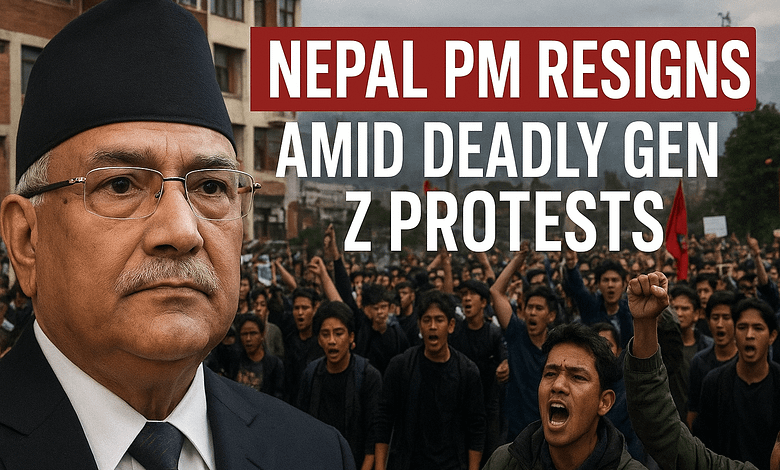
Breaking: Prime Minister Steps Down After 19 Deaths Rock the Himalayan Nation
In an unprecedented turn of events that has sent shockwaves across South Asia, Nepal’s Prime Minister KP Sharma Oli resigned on Tuesday, September 9, 2025, following two days of violent anti-corruption protests led by Generation Z that claimed 19 lives and left over 340 people injured. The resignation marks a dramatic culmination of youth-driven unrest that began with a controversial social media ban and escalated into the most significant political upheaval Nepal has witnessed in decades.ndtv+2
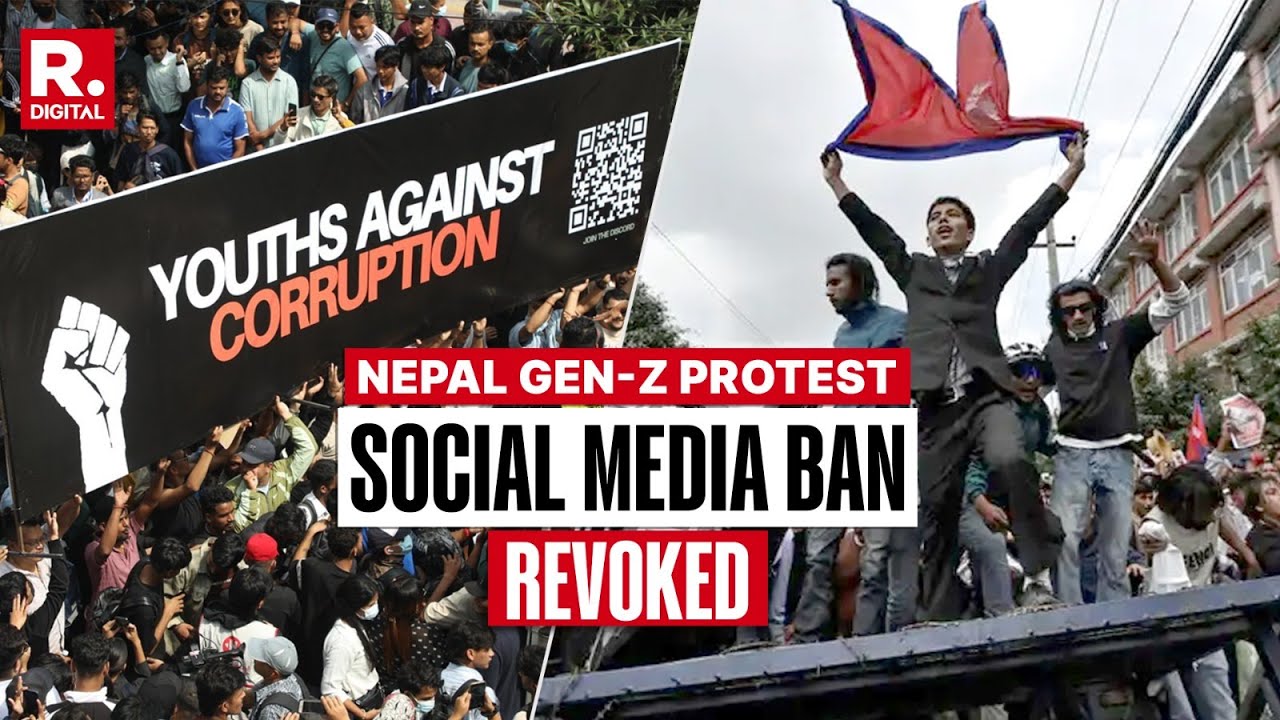
Nepal Gen Z youth protest against corruption amid social media ban revocation youtube
The Spark That Ignited a Revolution
The crisis erupted on September 4, 2025, when the Nepalese government imposed a sweeping ban on 26 major social media platforms, including Facebook, Instagram, YouTube, X (formerly Twitter), WhatsApp, LinkedIn, and Snapchat. The government justified this drastic measure by claiming these platforms had failed to register with the Ministry of Communication and Information Technology within a mandated deadline, citing concerns about misinformation, hate speech, and online fraud.nytimes+3
However, the ban struck a nerve with Nepal’s digitally native Generation Z population, who viewed it as an attack on their fundamental right to free expression and communication. For young Nepalis, social media represents far more than entertainment—it serves as their primary platform for political discourse, business opportunities, and connection with the nearly 7 million Nepalis working abroad.ndtv+3
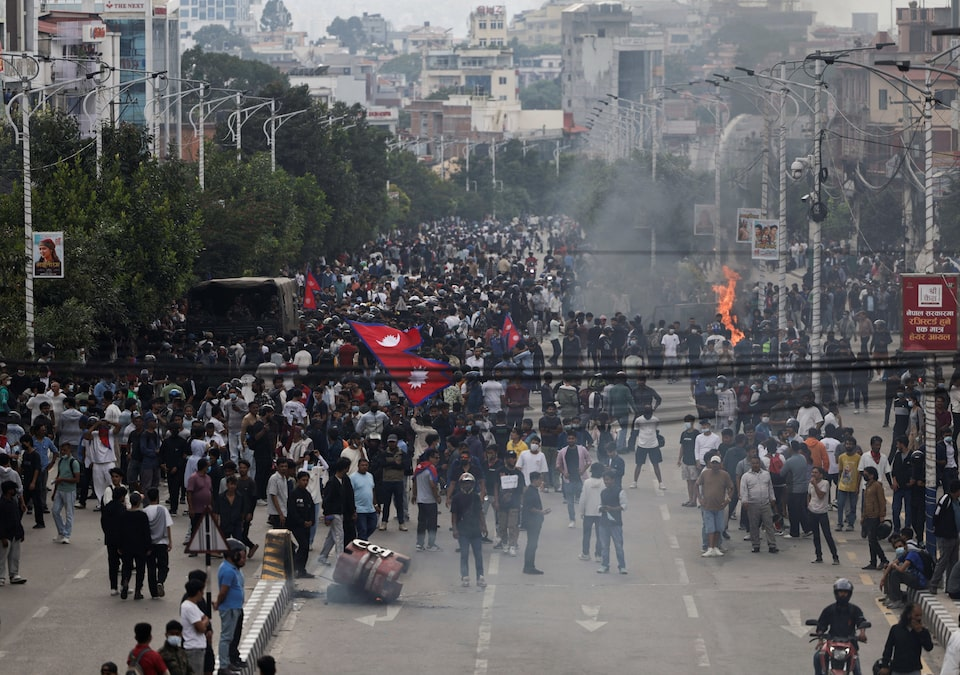
Large crowds of protesters in Kathmandu, Nepal, waving national flags amid smoke and fire during Gen Z social media ban demonstrations in September 2025 reuters
The ‘Nepo Kids’ Campaign: Exposing Elite Privilege
The social media ban coincided with a viral campaign known as “Nepo Kids,” which had been gaining momentum in the weeks leading up to the protests. This grassroots movement highlighted the stark contrast between the lavish lifestyles of politicians’ children—showcasing their luxury cars, foreign education, and expensive vacations—and the daily struggles of ordinary Nepalis.ndtv+3 https://www.mindviewmagazine.com/
Videos and posts under hashtags like #NepoKids, #NepoBabies, and #PoliticiansNepoBabyNepal went viral, with users questioning how these extravagant lifestyles were funded. “Nepo Kids show off their lifestyle on Instagram and TikTok, but never explain where the money comes from,” one widely shared TikTok video commented.timesofindia.indiatimes+2
This campaign tapped into deep-seated frustrations about systemic corruption and nepotism that have plagued Nepal’s political landscape for decades. The timing of the social media ban, many believed, was a deliberate attempt to silence this growing anti-corruption movement.economictimes+2 https://www.mindviewmagazine.com/chicago-mayor-signs-order-aimed-at-resisting-trumps-planned-immigration-crackdown/
Monday Massacre: When Protests Turned Deadly
On September 8, 2025, thousands of young protesters, many in school uniforms, converged on Kathmandu’s Maitighar Mandala and the Federal Parliament building in what organizers called “demonstrations by Gen Z”. The protests, initially peaceful, carried placards with slogans such as “Shut down corruption and not social media,” “Unban social media,” and “Take action against corrupt leaders”.ndtv+4
The situation rapidly deteriorated when protesters breached security barricades and entered restricted zones around Parliament. Security forces responded with tear gas, water cannons, rubber bullets, and ultimately live ammunition. The crackdown was swift and brutal, with police firing indiscriminately into crowds of young demonstrators.wikipedia+4
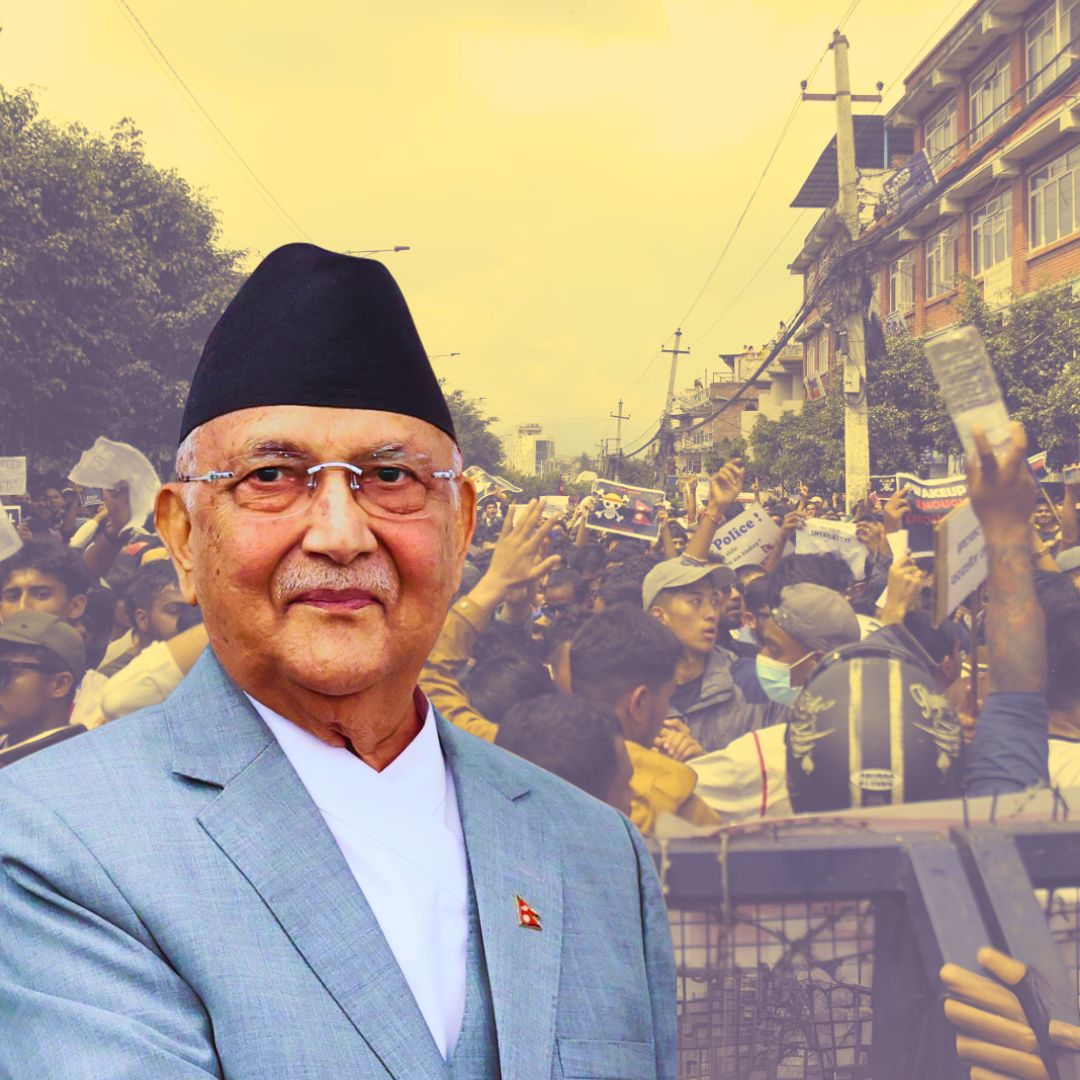
Nepal Prime Minister KP Sharma Oli with protestors demonstrating in the background amid political unrest thelogicalindian
By the end of Monday, at least 19 people were confirmed dead—17 in Kathmandu and 2 in Itahari, Sunsari district—with over 340 injured. The casualties included protesters as young as 12, according to reports. Hospitals across the country struggled to accommodate the influx of wounded, with many facilities providing free treatment to injured protesters.ndtv+4
Human Rights Watch condemned the police use of lethal force, calling it an “appalling disregard for the lives of its own citizens”. The international community, including the UN Human Rights Office, expressed shock at the killings and demanded transparent investigations.hrw+1
Government in Freefall: Ministers Resign En Masse
The deadly crackdown triggered an immediate political crisis within Oli’s coalition government. Home Minister Ramesh Lekhak became the first casualty, resigning on moral grounds just hours after the violence. His departure was quickly followed by Agriculture Minister Ramnath Adhikari and Health and Population Minister Pradip Poudel, both citing the government’s harsh response to student protests.economictimes+1
In a desperate attempt to contain the crisis, the government reversed the social media ban late Monday evening, with Communication and Information Technology Minister Prithvi Subba Gurung announcing that all platforms were operational again. However, this concession proved too little, too late.reuters
Tuesday’s Escalation: Burning Down the System
Despite the restoration of social media access and the imposition of curfews in Kathmandu and several other cities, protests intensified on Tuesday. Demonstrators, undeterred by the previous day’s violence, took their anger directly to the doorsteps of power.reuters+1
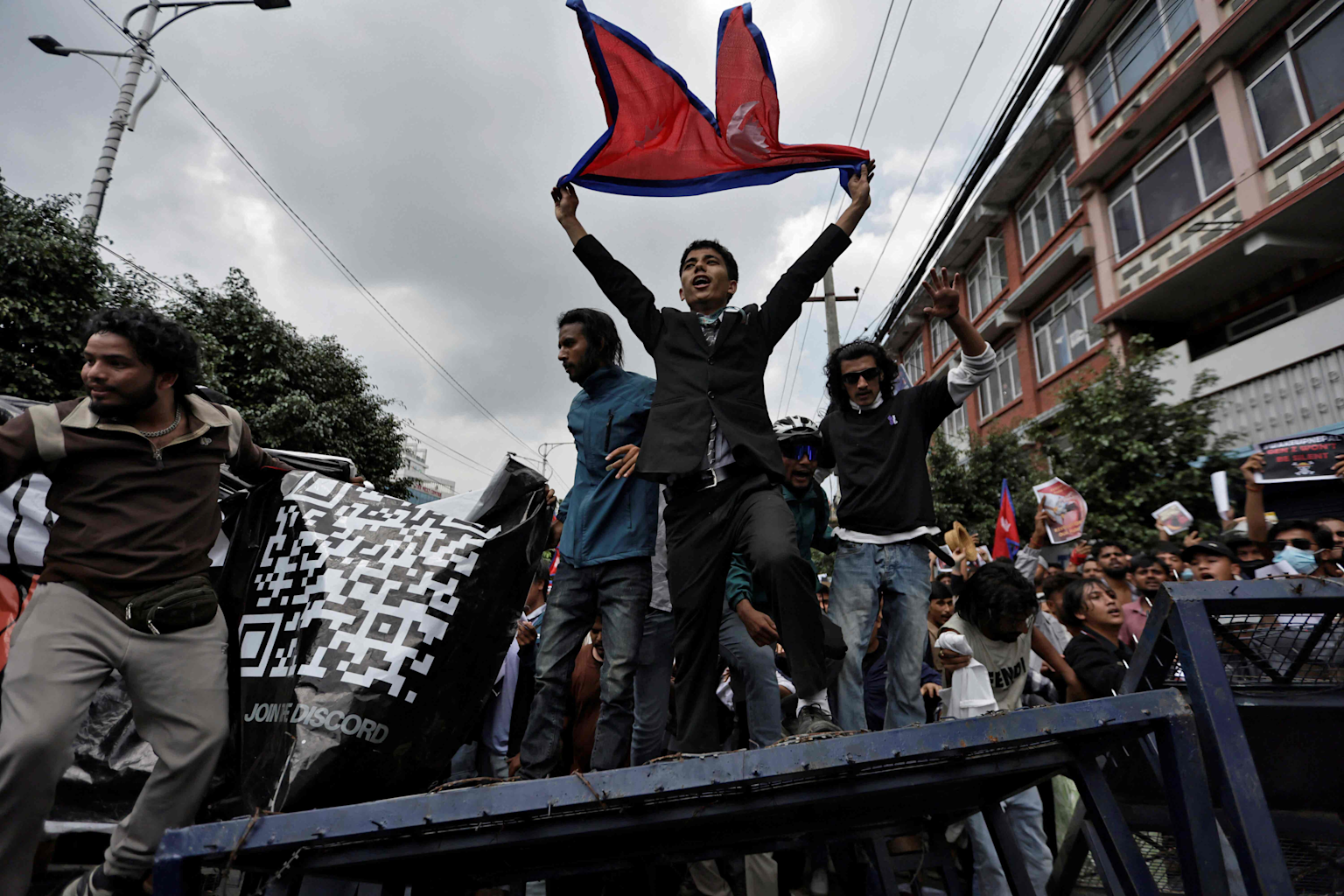
Youth protesters in Kathmandu raise a Nepalese flag amid Gen Z protests demanding political change in September 2025 nytimes
In unprecedented scenes that shocked the nation, protesters set fire to multiple high-profile targets:ndtv+2
- Prime Minister Oli’s private residence in Bhaktapur
- President Ram Chandra Poudel’s house in Kathmandu, with viral videos showing dozens of protesters inside, damaging portraits
- Former Home Minister Ramesh Lekhak’s residence in Naikap
- The headquarters of major political parties, including the Nepali Congress central office
- Various ministerial quarters and government buildings
The Nepal Army was deployed to secure vital installations, including Parliament and Tribhuvan International Airport, which was forced to shut down completely due to security concerns and smoke from nearby fires. All domestic and international flights were cancelled, stranding thousands of passengers.cnbctv18+3
The Prime Minister’s Last Stand
As his government crumbled around him, PM Oli made a final attempt to salvage his position by calling an all-party meeting for Tuesday evening and appealing for calm. “Any form of violence is not in the national interest. We must adopt peaceful dialogue and discussion,” Oli stated in what would be among his last public remarks as Prime Minister.indiatoday+1
However, reports emerged that Oli had been in contact with Nepal Army Chief General Ashok Raj Sigdel, seeking military assistance to control the situation and ensure his safe exit from the Prime Minister’s residence. Crucially, the Army Chief reportedly advised him to step down, stating that the military could only stabilize the situation if he relinquished power.indiatoday
The Resignation and Constitutional Crisis
At approximately 4:30 PM on Tuesday, September 9, Oli submitted his resignation to President Ram Chandra Poudel, stating in his letter that he was stepping down “to facilitate a solution to the problem and to help resolve it politically”. The resignation was quickly accepted, with military helicopters evacuating key government officials to Tribhuvan International Airport for their safety.indiatoday+2
However, Oli’s departure has created significant constitutional uncertainty. While the Prime Minister has resigned, President Poudel remains in office despite his residence being attacked and set ablaze. Under Nepal’s constitutional framework, the President serves as the head of government, and sources suggest it may only be a matter of time before he too steps down, potentially leading to a complete governmental collapse.ndtv+1
This scenario has raised concerns about potential military intervention, mirroring unfortunate precedents in Sri Lanka (2022) and Bangladesh (2024), where anti-corruption protests led to government collapses and military involvement.youtubendtv
Gen Z: Digital Natives Demanding Change
The protesters calling themselves “Gen Z”—referring to those born between 1997 and 2012—represent Nepal’s first generation of true digital natives. Unlike previous protest movements dominated by established political parties, these demonstrations were notable for their grassroots organization and explicit rejection of traditional party politics.ndtv+1
Organizers specifically asked political parties and their youth wings to stay away, emphasizing that this was a purely citizen-driven movement. The protesters, many still in school uniforms, represented a generation that has grown up with smartphones and social media as integral parts of their lives.indianexpress+2
This demographic faces particularly dire economic prospects. Nepal’s youth unemployment rate for those aged 15-24 stands at a staggering 22.7 percent, having nearly tripled from 7.3 percent in 1995-96. An estimated 1,500 to 1,700 young Nepalis leave the country daily seeking employment abroad, primarily in Gulf countries, Malaysia, and India.blogs.lse+2
Economic Underpinnings of Unrest
The protests reflect deeper structural problems plaguing Nepal’s economy. The country faces severe unemployment, with the overall rate climbing to 12.6 percent in 2022-23 from 11.4 percent five years earlier. Only 32.4 percent of the population is employed, while 62.9 percent are not in the labor force.theannapurnaexpress
Economic inequality has become increasingly stark. While average per capita income has risen significantly over recent decades, the benefits have been concentrated among the elite. The richest 20 percent saw their per capita income surge from Rs 19,325 to Rs 259,867, while the poorest 20 percent experienced only modest increases.theannapurnaexpress
This disparity has fueled massive migration, with over 6.8 million Nepalis receiving labor approval for overseas jobs over the past three decades, excluding those working in India. Remittances now account for over 30 percent of Nepal’s GDP, highlighting the country’s failure to create adequate domestic employment opportunities.edition.cnn+3
Regional Pattern of Youth Uprising
The Nepal protests are part of a broader pattern of youth-led movements across South Asia that have successfully toppled governments. In Sri Lanka (2022), Generation Z protesters occupied the presidential palace and forced President Gotabaya Rajapaksa to resign amid economic collapse. In Bangladesh (2024), student-led protests against the quota system eventually led to Prime Minister Sheikh Hasina’s ouster.youtube+1
These movements share common characteristics: they begin with specific grievances but evolve into broader anti-corruption campaigns, are primarily organized through social media, and involve predominantly young participants frustrated with entrenched political elites.youtube+1hindi.news18
International Response and Implications
The international community has responded with concern to the unfolding crisis in Nepal. A joint statement from the embassies of Australia, Finland, France, Japan, South Korea, the United Kingdom, and the United States expressed deep sadness over the violence and tragic loss of life.ndtv
India, as Nepal’s largest neighbor and key partner, issued an advisory urging Indian nationals in Nepal to exercise caution and adhere to local guidelines. The Indian Foreign Ministry noted that as “a close friend and neighbor,” India hoped all parties would exercise restraint and address issues through peaceful dialogue.ndtv
The Monarchy Question: A Return to the Past?
The current crisis has reignited discussions about Nepal’s political system and even sparked speculation about a potential return to monarchy. Nepal abolished its 239-year-old monarchy in 2008, but recent years have seen growing pro-monarchy sentiment amid political instability and economic stagnation.ndtv+2
Former King Gyanendra Shah, who was forced to abdicate in 2008, has been making public appearances and meeting with supporters in recent months. Pro-monarchy protests earlier in 2025 attracted tens of thousands of participants, with demonstrators chanting “Bring king back to the throne and save the country”.ndtv+3
However, the current Gen Z protests appear fundamentally different from pro-monarchy demonstrations, focusing instead on anti-corruption measures, democratic accountability, and systemic reform rather than monarchist restoration.ndtv+1
The Path Forward: Uncertain Political Landscape
As Nepal enters uncharted political territory, several scenarios remain possible. The country could see the formation of a new government through constitutional means, potentially led by different political configurations. However, the complete breakdown of public trust in traditional political parties poses significant challenges.kathmandupost+1
The protesters have made clear that cosmetic changes will not suffice. Their demands extend beyond individual resignations to structural reforms addressing corruption, nepotism, and economic inequality. The movement’s emphasis on accountability and transparency reflects a generational shift in political expectations.ndtv+2
The Nepal Army’s role will be crucial in determining the country’s immediate future. While military leaders have called for public restraint, the institution’s position regarding potential political transitions remains unclear.myrepublica.nagariknetwork
Economic Consequences and Recovery Challenges
The political crisis comes at a particularly vulnerable time for Nepal’s economy. The closure of Tribhuvan International Airport and cancellation of all flights have immediately impacted tourism and business operations. The unrest has also raised concerns about investor confidence and the country’s ability to attract foreign investment.blogs.lse+2
With over 7 million Nepalis living abroad and remittances comprising such a significant portion of GDP, political instability could affect these crucial financial flows. The crisis may also impact ongoing development projects and international aid programs.thehimalayantimes+1
Media and Digital Rights Implications
The social media ban that triggered the protests has broader implications for digital rights across South Asia. The government’s attempt to control online discourse by blocking major platforms highlights the tension between state control and digital freedom in the region.nytimes+1
The effectiveness of young protesters in organizing despite the social media ban—using alternatives like TikTok and VPN technology—demonstrates the resilience of digital native movements. This has implications for how governments across the region approach social media regulation and online dissent.economictimes+2
Looking Ahead: Lessons from Nepal’s Crisis
Nepal’s crisis offers several lessons for democratic governance in South Asia:
Youth Political Engagement: The protests demonstrate that excluding young people from meaningful political participation carries significant risks. With youth comprising nearly half of Nepal’s population, their political mobilization represents a fundamental shift that traditional parties ignore at their peril.ndtv+1
Digital Age Governance: The government’s heavy-handed approach to social media regulation backfired spectacularly, showing that attempts to control online discourse in the digital age can trigger rather than prevent political unrest.nytimes+1
Anti-Corruption Imperatives: The “Nepo Kids” campaign’s viral success illustrates how social media can expose elite privilege and corruption in ways that traditional media cannot. This creates new accountability pressures on political leaders.ndtv+2
Regional Stability Concerns: The pattern of youth-led movements successfully challenging governments across South Asia suggests this may not be an isolated phenomenon but part of a broader regional transformation.youtube+1
Conclusion: A Generation Demands Change
As this comprehensive analysis shows, Nepal’s political crisis represents more than just another governmental collapse—it signals a generational awakening that could reshape the country’s political landscape permanently. The Gen Z protesters who brought down Prime Minister Oli’s government have demonstrated that digital native movements can successfully challenge entrenched power structures when mobilized around clear grievances.ndtv+2
The resignation of PM Oli, while significant, may only be the beginning of broader political transformation in Nepal. The underlying issues that drove millions of young Nepalis to risk their lives in protest—corruption, economic inequality, lack of opportunities, and democratic deficits—remain unaddressed.indianexpress+2
Whether Nepal emerges from this crisis with strengthened democratic institutions or faces prolonged instability will depend largely on how effectively the political establishment responds to the legitimate grievances raised by its youngest citizens. One thing is certain: the generation that grew up with smartphones in their hands and democratic ideals in their hearts will not accept a return to business as usual.ndtv+1
The events in Nepal serve as both a warning and an inspiration to governments across South Asia and beyond. In an age of digital connectivity and youth activism, attempts to suppress dissent through heavy-handed measures may only amplify the very voices authorities seek to silence. The young protesters of Nepal have shown that when a generation decides it has had enough, even prime ministers must listen—or face the consequences of their indifference.
As Nepal begins the difficult process of political reconstruction, the world watches to see whether this Himalayan nation can transform the energy and passion of its Gen Z uprising into lasting democratic renewal. The stakes could not be higher, not just for Nepal’s 30 million citizens, but for the broader future of democratic governance in a region where young people increasingly refuse to accept the failures of their elders.blogs.lse+2 https://www.mindviewmagazine.com/