Bharat Bandh Live: 25 Crore Workers Join Nationwide Strike
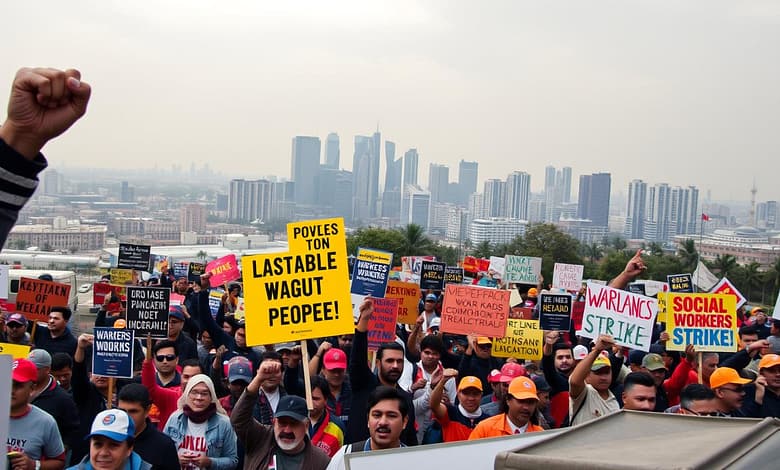
A massive nationwide strike has brought India to a standstill as 25 crore workers participated in the Bharat Bandh, disrupting various industries across the nation.

The impact of this strike is significant, with widespread participation reported in major cities and towns, affecting transportation, healthcare, and other critical sectors.
As the situation unfolds, the bharat bandh today live updates indicate a strong show of solidarity among workers, highlighting the scale and unity of the strike.
Key Takeaways
- Massive participation of 25 crore workers in the nationwide strike.
- Widespread disruption across various industries.
- Significant impact on transportation and healthcare sectors.
- Strong show of solidarity among workers.
- Continued updates on the situation as it unfolds.
Bharat Bandh Today Live: 25 Crore Workers Expected to Participate in Nationwide Strike
India is on the cusp of a major labor strike as the Bharat Bandh call is expected to draw in 25 crore workers nationwide. This significant event is poised to impact various sectors and regions, making it a critical day for the country’s workforce and economy.
Understanding the Scale: What 25 Crore (250 Million) Workers Means
The number “25 crore” translates to 250 million workers, a staggering figure that represents a substantial portion of India’s workforce. To put this into perspective, it’s essential to understand the diverse sectors and industries that these workers are employed in.
Key Statistics:
- 250 million workers expected to participate
- Multiple industries affected, including manufacturing, transportation, and public services
- Widespread impact across various regions in India
Key Regions and Industries Affected
The Bharat Bandh is expected to have a far-reaching impact on several key regions and industries across India. Some of the most affected areas are likely to include:
Regions:
- Delhi NCR: Being the capital, it is expected to see significant disruptions.
- Mumbai: As a major financial hub, any shutdown here will have considerable economic implications.
- Kolkata: Historical significance and labor union strength make it a crucial location for the strike.
Industries:
- Manufacturing: Production and supply chains will be severely impacted.
- Transportation: Public transport, including buses and trains, may face disruptions.
- Public Services: Government offices and public utilities might experience operational challenges.
The scale of participation and the broad range of affected industries underscore the significance of this nationwide strike. As the day unfolds, the impact on the economy and daily life will become clearer.
What is Bharat Bandh? Understanding the Nationwide Shutdown
Bharat Bandh, a term that translates to ‘India shutdown,’ is a form of nationwide strike that brings the country to a standstill. It is typically called by political parties, trade unions, or other organizations to protest against government policies, economic conditions, or social issues.
The concept of Bharat Bandh has been a part of India’s protest culture for decades, with the first recorded bandh dating back to 1973. Since then, it has been used numerous times to draw attention to various causes.
Historical Context of Bandhs in India
The history of bandhs in India is closely tied to the country’s struggle for independence and subsequent social and economic movements. The practice of calling for a bandh was initially used during the freedom struggle as a form of civil disobedience against British rule.
Over time, bandhs became a common method for various groups to express their grievances against the government. The frequency and scale of bandhs have varied over the years, with some periods seeing more intense activity than others.
Legal Status of Nationwide Strikes
The legal status of nationwide strikes, including Bharat Bandh, is a complex issue. While the right to strike is not explicitly mentioned in the Indian Constitution, it is considered an essential aspect of the freedom of speech and expression.
Supreme Court Rulings on Bandhs
The Supreme Court of India has delivered several judgments related to bandhs, attempting to balance the right to protest with the need to maintain law and order. In one landmark judgment, the Court ruled that bandhs are not illegal per se, but their legality depends on the context and the manner in which they are carried out.
The following table summarizes key Supreme Court rulings on bandhs:
| Year | Ruling | Impact |
|---|---|---|
| 2004 | Bandhs are not illegal per se, but their legality depends on the context. | Allowed for more nuanced interpretation of bandhs. |
| 2015 | Directed states to take measures to prevent violence during bandhs. | Enhanced government responsibility to maintain law and order. |
| 2020 | Emphasized the need for peaceful protests. | Reinforced the importance of non-violent demonstrations. |
In conclusion, Bharat Bandh is a significant form of protest in India, with a rich historical context and complex legal status. Understanding the nuances of bandhs is crucial for appreciating their impact on the country.
Key Demands and Reasons Behind the Current Strike
A massive strike involving 25 crore workers is currently underway in India, focusing on labor rights and economic reforms. This strike is a significant event, highlighting the unity and determination of workers across various industries.
Labor Rights Issues at the Forefront
The strike brings to the forefront several labor rights issues that have been concerning workers for a long time. These include demands for better working conditions, job security, and protection against unfair labor practices.
Key labor rights demands:
- Improved workplace safety standards
- Protection against unfair dismissals
- Enhanced workers’ rights to form unions
Economic Policies Under Protest
The strike is also a protest against certain economic policies that workers feel are detrimental to their welfare. These policies include changes in labor laws and economic reforms that are perceived as anti-worker.
Minimum Wage Demands
One of the critical demands of the striking workers is the implementation of a higher minimum wage. Workers argue that the current minimum wage is not sufficient to meet the rising cost of living.
| State | Current Minimum Wage | Demanded Minimum Wage |
|---|---|---|
| Delhi | ₹13,350 per month | ₹18,000 per month |
| Maharashtra | ₹12,900 per month | ₹17,000 per month |
| Tamil Nadu | ₹12,300 per month | ₹16,500 per month |
The strike is a significant demonstration of the workers’ resolve to achieve their demands, including a higher minimum wage and better labor rights.
Trade Unions and Organizations Leading the Nationwide Protest
The nationwide strike is a result of combined efforts from various trade unions and supporting organizations. This collective action underscores the unity and determination of the workforce across different sectors.
Major Union Participation
Several major trade unions are at the forefront of the nationwide strike. These include:
- The All India Trade Union Congress (AITUC)
- The Indian National Trade Union Congress (INTUC)
- The Centre of Indian Trade Unions (CITU)
These unions represent millions of workers from various industries, including manufacturing, services, and public sectors.
| Union Name | Members (approx.) | Sectors Represented |
|---|---|---|
| AITUC | 1.4 million | Manufacturing, Services |
| INTUC | 3.5 million | Public Sector, Services |
| CITU | 2.7 million | Manufacturing, Public Sector |
Political Support and Alignments
The nationwide strike has garnered significant political support from various parties and organizations. The political backing adds another layer of complexity to the strike, as it involves not just labor issues but also broader political considerations.
Key political supporters include:
- The Communist Party of India (Marxist)
- The All India Congress Committee
These political parties have historically been aligned with the trade unions leading the strike, providing both moral and organizational support.
The alignment between trade unions and political parties is expected to influence the dynamics of the strike, potentially affecting its outcome and the government’s response.
Live Updates: How the Strike is Unfolding Across India
Live updates on the Bharat Bandh today reveal a widespread impact across various regions, with 25 crore workers participating in the nationwide strike.
Morning Developments
The day began with a strong show of solidarity among workers, with reports indicating significant disruptions in major cities.
- Strikes were reported in key industrial hubs.
- Public transportation was severely affected.
- Protest marches were organized in several states.
Key regions affected include major metropolitan areas and industrial centers, where workers have gathered to voice their demands.
Afternoon Situation
As the day progressed, the situation continued to unfold with reports of:
- Increased picketing at key infrastructure points.
- Escalating tensions between protesters and law enforcement.
- Continued disruptions in public services.
The strike’s impact is being felt across the nation, with many calling for a resolution to the labor disputes.
Evening Progress
By the evening, the strike had shown no signs of abating, with:
- Reports of clashes between protesters and police.
- Continued shutdowns of businesses and services.
- Union leaders calling for sustained action.
The strike is expected to continue into the next day, with widespread support from various trade unions.
As the situation develops, updates will continue to be provided, reflecting the ongoing progress of the Bharat Bandh.
Impact on Major Metropolitan Cities
As the Bharat Bandh continues, its impact on major metropolitan cities is becoming increasingly evident, with widespread closures and transportation halts.
Delhi NCR Situation
The Delhi NCR region is experiencing significant disruptions due to the strike. Traffic congestion is a major issue, with many roads blocked by protesters. The city’s public transportation system, including the metro, is operating on a limited schedule, causing inconvenience to daily commuters.

Mumbai Bandh Updates
In Mumbai, the strike has brought the city’s usually bustling streets to a standstill. Local train services, the lifeline of the city, are severely affected, with many services canceled or delayed. The strike has also impacted the city’s iconic markets, with many shops and businesses remaining closed.
Kolkata Strike Scenario
Kolkata is witnessing a mixed response to the strike. While some areas are observing the bandh with complete shutdowns, others are relatively unaffected. The city’s trams and buses are not operating, causing difficulties for commuters. However, some parts of the city are relatively normal, with people going about their daily business.
The strike has highlighted the unity and solidarity among the workers and trade unions across these metropolitan cities. As the situation continues to unfold, it is clear that the impact of the Bharat Bandh will be felt for some time.
Bengaluru Traffic News: Transportation Disruptions and Alternatives
Bengaluru’s traffic landscape is undergoing a significant transformation due to the nationwide strike. As a major metropolitan city, Bengaluru is experiencing considerable disruptions in its transportation networks.
Public Transport Status
The public transport system in Bengaluru, including buses and trains, is facing operational challenges. Many services are either canceled or running with reduced frequency.
- BMTC buses: Operating with reduced schedules; some routes are completely halted.
- Namma Metro: Services are available but with longer intervals between trains.
Traffic Hotspots to Avoid
Several areas in Bengaluru are expected to be heavily congested due to the strike. It’s advisable to avoid the following hotspots:
- MG Road
- Brigade Road
- Electronic City
Alternative Routes and Solutions
To navigate through Bengaluru during the strike, consider the following alternative routes and solutions:
| Route | Alternative |
|---|---|
| MG Road to Electronic City | Take Hosur Road or use the Outer Ring Road |
| Brigade Road to Koramangala | Use the Richmond Road or Kent Town route |
Additionally, leveraging ride-sharing services and carpooling can significantly reduce travel time and hassle.
Essential Services During the Bandh
As Bharat Bandh brings the nation to a standstill, the focus shifts to the essential services that remain operational. Despite the widespread strike, critical services continue to function, ensuring public safety and convenience.
Healthcare Accessibility
Healthcare services are expected to remain operational during the Bharat Bandh. Hospitals and emergency care units will continue to provide medical assistance, ensuring that patients receive the care they need.
- Emergency departments will remain open 24/7.
- Ambulance services will continue to operate.
- Pharmacies will remain open, although some may have limited hours.
Healthcare workers are exempt from the strike, and their dedication will ensure the continuity of medical services.
Banking and ATM Operations
Major banks and ATMs are expected to function normally during the bandh. While some bank branches might remain closed, ATM services will be available for customers to access their money.
- Major public sector banks will operate as usual.
- Private banks may have varying hours, with some branches open.
- ATMs will be operational across the country.
Emergency Services Functioning
Emergency services, including police, fire, and disaster response teams, will continue to operate during the Bharat Bandh. These services are crucial for maintaining law and order and responding to emergencies.
- Police departments will remain on high alert.
- Fire services will continue to operate.
- Disaster response teams will be ready to respond to any situation.
The continuity of these essential services will help mitigate the impact of the strike on daily life.
Economic Impact of the Nationwide Shutdown
As the strike unfolds, its economic impact is becoming increasingly apparent. The nationwide shutdown has brought various sectors to a standstill, resulting in significant financial repercussions.

Estimated Financial Losses
The strike is expected to result in substantial financial losses. Initial estimates suggest that the daily loss could run into billions of dollars, affecting the overall GDP of the country.
- Losses in the manufacturing sector due to halted production
- Decline in revenue from transportation and logistics
- Impact on the service sector, including IT and ITES
Sectors Most Affected
Several sectors are bearing the brunt of the strike:
- Transportation: Public transport and logistics have come to a grinding halt, affecting the movement of goods and people.
- Manufacturing: Production units have been shut down, leading to potential supply chain disruptions.
- Services: Many service-oriented businesses, including IT and financial services, are operating with reduced capacity or are completely shut down.
Impact on US-India Business Relations
The strike is also likely to have implications for US-India business relations. With many US companies having operations or significant business interests in India, the disruption is causing concern among American businesses and investors.
| Sector | Impact |
|---|---|
| IT and ITES | Delayed projects and potential loss of revenue |
| Manufacturing | Supply chain disruptions and production halts |
| Logistics and Transportation | Movement of goods and people severely affected |
The economic implications of the strike are far-reaching, affecting not just the domestic economy but also having a ripple effect on international business relations, particularly with the US.
Government Response to the Bharat Bandh
The government’s response to the Bharat Bandh has been multifaceted, involving both official communications and security enhancements. As the strike continues, the government remains engaged with union leaders while maintaining public order.
Official Statements
The government has issued several official statements addressing the strike. These statements emphasize the government’s commitment to addressing labor rights issues while maintaining national security and public order.
- Ministry of Labour and Employment has released a statement assuring dialogue with union representatives.
- The Home Ministry has announced measures to ensure public safety and prevent disruptions.
Security Measures Implemented
To maintain law and order, the government has deployed additional security personnel across key cities.
- Enhanced surveillance in major metropolitan areas.
- Deployment of paramilitary forces in sensitive regions.
Negotiations with Union Leaders
The government has initiated talks with union leaders to address the core demands of the striking workers.
- Labour ministry officials are engaging in discussions with representatives from major trade unions.
- Concessions are being considered in areas such as minimum wage and worker safety.
Previous Nationwide Strikes and Their Outcomes
India has witnessed numerous nationwide strikes throughout its history, each leaving a significant impact on the country’s socio-economic fabric. These strikes have been instrumental in shaping labor laws, influencing economic policies, and bringing attention to various social issues.
Historical Context of Previous Strikes
The history of nationwide strikes in India dates back to the pre-independence era, with significant events such as the Trade Union Movement in the early 20th century. Post-independence, strikes continued to be a tool for labor unions to negotiate with the government on various issues, including wages, working conditions, and social security.
Some notable historical strikes include:
- The 1981 Bank Strike, which led to significant improvements in the banking sector’s labor policies.
- The 1991 Economic Reforms protest, where unions opposed the liberalization policies.
- The 2016 Dalit Rights Protest, which highlighted issues of social inequality.
Comparative Analysis of Strike Outcomes
A comparative analysis of previous nationwide strikes reveals varying degrees of success in achieving their objectives. The impact of these strikes can be measured in terms of policy changes, public awareness, and the unity of the workforce.
| Year | Strike | Main Demands | Outcome |
|---|---|---|---|
| 1981 | Bank Strike | Better wages, improved working conditions | Significant improvements in banking sector labor policies |
| 1991 | Economic Reforms Protest | Opposition to liberalization policies | Mixed; some policies were adjusted, but overall reforms continued |
| 2016 | Dalit Rights Protest | Social equality, justice for Dalit community | Raised awareness, some policy changes, but issues persist |
Understanding the outcomes of previous nationwide strikes provides valuable insights into the effectiveness of such actions and helps in planning future movements.
Conclusion: The Significance of 25 Crore Workers Uniting in Protest
The nationwide strike, involving 25 crore workers, is a significant event that highlights the unity and solidarity of the workforce across India. This massive protest underscores the deep-seated issues related to labor rights and economic policies that have been a concern for workers.
The impact of this strike is far-reaching, with major metropolitan cities and various industries affected. The worker unity demonstrated during this nationwide strike sends a strong message to the government and other stakeholders about the need for reform.
The protest significance lies in its ability to bring attention to the plight of workers and the need for policies that support their welfare. As the situation unfolds, it will be crucial to monitor the government’s response and the negotiations with union leaders.
The unity and solidarity shown by workers across the country will likely have a lasting impact on labor policies and economic reforms in India.
FAQ
What is Bharat Bandh?
Bharat Bandh is a nationwide strike or shutdown called by various trade unions and organizations to protest against certain government policies or to demand labor rights.
How many workers are participating in the Bharat Bandh?
Approximately 25 crore (250 million) workers are expected to participate in the nationwide strike, making it a massive protest.
Which regions and industries are affected by the strike?
The strike is expected to affect various regions and industries across India, including major metropolitan cities like Delhi, Mumbai, and Bengaluru.
What are the key demands of the striking workers?
The key demands include labor rights issues, minimum wage demands, and protests against certain economic policies.
How is the government responding to the Bharat Bandh?
The government has issued official statements and implemented security measures to manage the strike. Negotiations with union leaders are also underway.
Are essential services available during the Bharat Bandh?
Yes, essential services like healthcare, banking, and emergency services are expected to continue functioning during the strike.
What is the economic impact of the nationwide shutdown?
The strike is expected to result in significant financial losses, affecting various sectors and potentially impacting US-India business relations.
How is the strike unfolding in major cities like Bengaluru and Mumbai?
Live updates indicate that the strike is causing transportation disruptions and other challenges in major cities. Alternative routes and solutions are being suggested to mitigate the impact.
What is the historical context of bandhs in India?
Bandhs have been a part of India’s protest culture for decades, with various trade unions and organizations calling for nationwide strikes to demand their rights.
How does the current strike compare to previous nationwide strikes?
The current strike is one of the largest in terms of participation, with 25 crore workers joining the protest. A comparative impact analysis can provide insights into its effectiveness.